
Introduction
Mike, a construction manager in California, stood on site staring at a problem he didn’t expect. The structural and MEP teams had followed different drawings. Pipes clashed with beams. Work stopped. Time slipped. Costs rose.
He had seen this before. Most projects faced the same issue-miscommunication, design gaps, and last-minute fixes. No matter how skilled the teams were, traditional workflows left too much room for error.
Then Mike tried a different approach on his next project. His team used BIM services from the start. Before any physical work began, they built a detailed digital model. Every system, every element, and every connection was visible.
Clashes showed up early. Teams fixed them before stepping on site. Schedules became clear. Costs stayed under control. The project moved with fewer surprises.
This shift is now common across the USA. Construction firms no longer rely only on drawings and manual coordination. They use BIM services to plan better, coordinate faster, and deliver with confidence.
BIM is not just a tool. It is changing how modern construction projects work from start to finish.
What Are BIM Services?
BIM services help teams plan, design, and manage construction projects through a digital model. This model is not just a drawing. It holds detailed information about every part of the building.
In traditional methods, teams worked with separate drawings. Architects, engineers, and contractors often used different files. This led to gaps and confusion. BIM brings everything into one shared model. Everyone works on the same data.
At the core, BIM services include several key parts. 3D modeling creates a clear visual of the project. Teams can see how the building will look and function before construction starts.
Clash detection checks for conflicts between systems like structure, plumbing, and electrical. It helps fix issues early and avoid costly changes later.
4D BIM adds time to the model. Teams can plan each phase of construction and track progress.
5D BIM adds cost data. This helps manage budgets with more accuracy.
Another important service is Scan to BIM. It converts real-world site data into a digital model. This is useful for renovation and retrofit projects.
In simple terms, BIM services turn ideas into a smart, coordinated plan. They help teams build with clarity and control.
Current State of BIM Adoption in the USA
BIM adoption in the USA has moved from optional to essential. Most large firms now rely on it for daily project work.
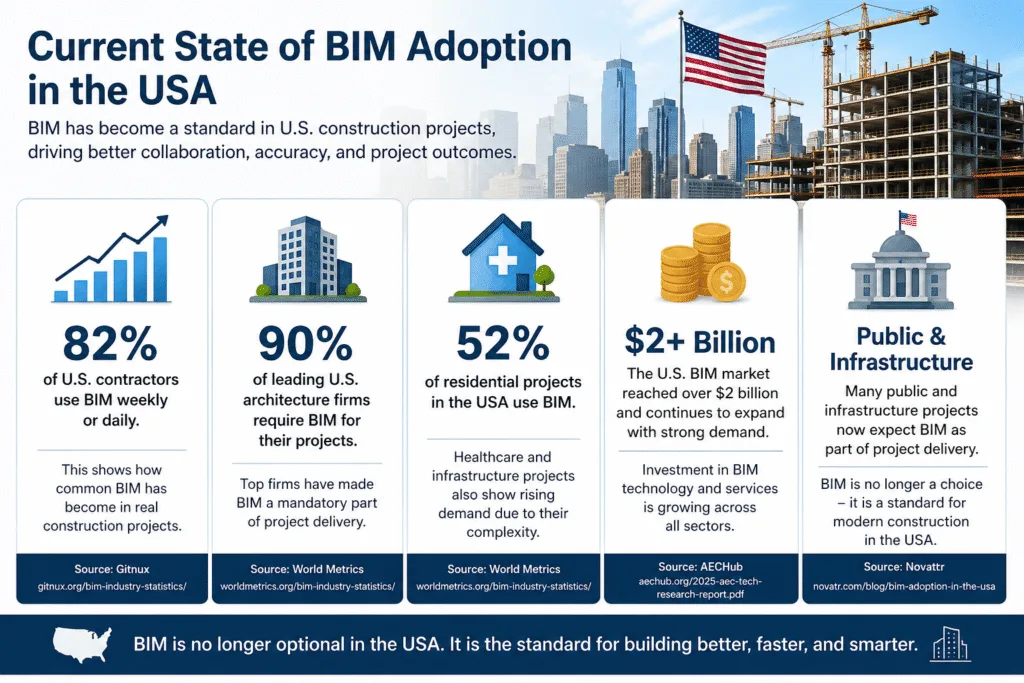
Recent data from gitnux shows that 82% of U.S. contractors use BIM weekly or daily, which highlights how common it has become in real projects.
Adoption is even stronger at the top level. Around 90% of leading U.S. architecture firms require BIM for their projects.
In specific sectors, usage continues to grow. For example, 52% of residential projects in the USA use BIM, while healthcare and infrastructure projects also show rising demand due to their complexity.
Market growth also supports this trend. The U.S. BIM market reached over $2 billion and continues to expand with strong demand.
Many public and infrastructure projects now expect BIM as part of project delivery.
This shows a clear shift. In the USA, BIM is no longer a choice. It is a standard for modern construction projects.
Read More: How the BIM Market Is Transforming Global Construction in 2026Key Ways BIM Services Are Transforming Construction Projects
BIM services bring real change to how construction projects run in the USA. They improve planning, coordination, and execution at every stage.
Improved Project Visualization
BIM creates clear 3D models of the project. Teams can see the full design before work starts. Clients also understand the layout better. This reduces confusion and speeds up approvals.
Clash Detection and Error Reduction
BIM helps detect clashes between systems early. Structural, plumbing, and electrical elements stay aligned. Teams fix issues in the design phase. This reduces rework and saves time on site.
Better Collaboration Across Teams
All teams work on a shared model. Any update reflects across the system. This keeps architects, engineers, and contractors on the same page. It reduces miscommunication and delays.
Time and Cost Control (4D & 5D BIM)
BIM links design with time and cost. Teams can plan each phase with more clarity. They track progress and adjust plans when needed. This helps avoid delays and budget overruns.
Support for Prefabrication
BIM plays a key role in prefabrication. It provides accurate data for offsite production. Fabricators can build components with precision. This speeds up construction and reduces material waste.
Data-Driven Decisions
BIM models hold detailed project data. Teams can use this data to make better decisions. They can analyze risks, plan resources, and improve outcomes. This reduces guesswork in project management.
Improved Quality and Safety
BIM helps identify risks before construction starts. Teams can plan safety measures in advance. It also ensures that designs meet project standards. This leads to better quality and safer sites.
BIM services turn complex construction work into a more controlled process. They help teams build faster, smarter, and with fewer surprises.
Real-World Application in the USA
A strong example of BIM in action is the California High-Speed Rail project. This is one of the largest infrastructure projects in the United States. It connects major cities and involves complex design across long distances.

Teams use BIM to manage every stage of the project. The digital model helps engineers plan routes, design structures, and coordinate multiple systems. It also allows teams in different locations to work on the same data.
With BIM, clashes between design elements get identified early. This reduces delays and avoids costly changes during construction. It also helps track progress and manage schedules with more accuracy.
According to industry insights, large infrastructure projects in the USA now rely heavily on BIM to improve efficiency and coordination.
This example shows how BIM supports better planning and smoother execution in complex project
Benefits of BIM Services for Modern Projects
BIM services help construction teams work with more clarity and control. They reduce errors, improve coordination, and support better planning from start to finish. Instead of reacting to problems on site, teams can solve them during the design stage. This leads to smoother execution and better project outcomes.
Improved accuracy: Detailed models reduce design errors and confusion
Faster project delivery: Early planning helps avoid delays on site
Cost savings: Clash detection reduces rework and material waste
Better coordination: All teams work on a shared and updated model
Enhanced visualization: Clear 3D models improve design understanding
Stronger safety planning: Risks get identified before construction begins
Data-driven decisions: Teams use real data to plan and manage projects
Read More: Why Outsourcing BIM Has Become the Great Strategy for Construction FirmsChallenges in BIM Implementation
While BIM offers many benefits, its adoption can come with challenges. Many firms struggle at the start due to cost, training needs, and system changes. Without proper planning, these issues can slow down implementation. However, most of these challenges can be managed with the right approach and support.
High initial investment: Software and setup costs can be high
Training requirements: Teams need time to learn new tools and workflows
Data management issues: Poor data can affect model accuracy
System integration: Existing tools may not connect easily with BIM
Resistance to change: Teams may prefer traditional methods
Maintenance needs: BIM systems require regular updates and monitoring
Read More: Challenges of implementing BIM in construction projects.Why Choose a Professional BIM Service Provider
BIM tools alone cannot deliver results. The real value comes from how they are used. A professional BIM service provider brings the expertise needed to create accurate models, manage data, and ensure smooth coordination across teams.
Working with experts helps reduce errors, save time, and improve project outcomes. It also allows companies to adopt advanced workflows without building large in-house teams.
Next Synergy Solution is a leading BIM service provider in the USA. The company supports architects, engineers, and contractors with reliable and high-quality BIM solutions. From clash detection to Scan to BIM and full project coordination, the team focuses on precision and efficiency.
With the right partner, construction firms can use BIM services to deliver projects faster, reduce risks, and stay competitive in a growing industry.
Conclusion
Mike no longer stands on site dealing with unexpected clashes and delays. His projects now start with clarity and move with confidence. With BIM services in place, his team plans every detail before construction begins.
Design conflicts get resolved early. Teams stay aligned. Costs remain under control. What once felt uncertain now follows a clear path.
This change reflects a larger shift across the USA construction industry. BIM services are not just improving workflows. They are changing how projects get delivered. From better coordination to smarter planning, teams now build with fewer risks and better results.
Firms that adopt BIM gain a clear advantage. They save time, reduce errors, and deliver higher quality projects. Those who delay often face the same old challenges.
In today’s construction world, success depends on how well you plan before you build. BIM services make that possible.