

You’ve probably noticed how fast the construction world is changing. Deadlines feel tighter, clients expect more detail, and projects grow complex every year. As an architect or contractor, you already juggle countless tasks-design, coordination, budgeting, and team management. Then comes BIM, a game-changer that promises precision and efficiency but often demands heavy resources and expertise.

That’s where outsourcing steps in. Many modern firms now rely on trusted BIM partners who handle modeling, coordination, and data with speed and accuracy. It’s not just about cutting costs-it’s about working smarter, scaling faster, and focusing on what truly matters: design and delivery. Whether you manage residential builds or commercial towers, outsourcing BIM can transform how you approach every project.
Ready to discover why it’s become the great strategy for architects and modern construction firms? Let’s get started with the blog.
Global BIM Adoption Trends
In recent years, BIM Modeling Service has moved from being an optional tool to becoming an essential part of modern construction. Across the world, firms are no longer asking if they should use BIM but how fast they can adopt it.
According to research from Global Growth Insights, the BIM market is evolving rapidly as stakeholders in architecture, engineering, and construction embrace automation and digital collaboration platforms.
Around 68% of global construction projects now use BIM for planning, visualization, and risk management. Integration with AI, VR, and IoT has improved accuracy and reduced project overruns by 32%, while over 45% of firms report stronger coordination through cloud-based BIM systems.
This transformation is visible across regions. Europe leads with government-backed BIM mandates, especially in the UK and Scandinavia. North America follows closely, driven by innovation and demand for high-performance buildings. In Asia-Pacific, countries like India, Singapore, and Japan are pushing BIM adoption through large-scale infrastructure and smart city programs.
Even emerging markets in the Middle East and Africa are now leveraging BIM for public-private partnerships and sustainable urban development. The industry’s evolution signals one thing clearly: BIM is no longer the future; it’s the present standard for building excellence.
Read More :How the BIM Market Is Transforming Global Construction in 2025Key Benefits of Outsourcing BIM for Architects and Construction Firms
Outsourcing BIM has become one of the most practical strategies for architecture and construction companies aiming to boost efficiency, precision, and cost control. By partnering with specialized BIM service providers, firms gain access to advanced tools, skilled professionals, and proven workflows-without the heavy expense of building in-house capabilities. The benefits go far beyond savings; they redefine how projects are planned, coordinated, and executed.
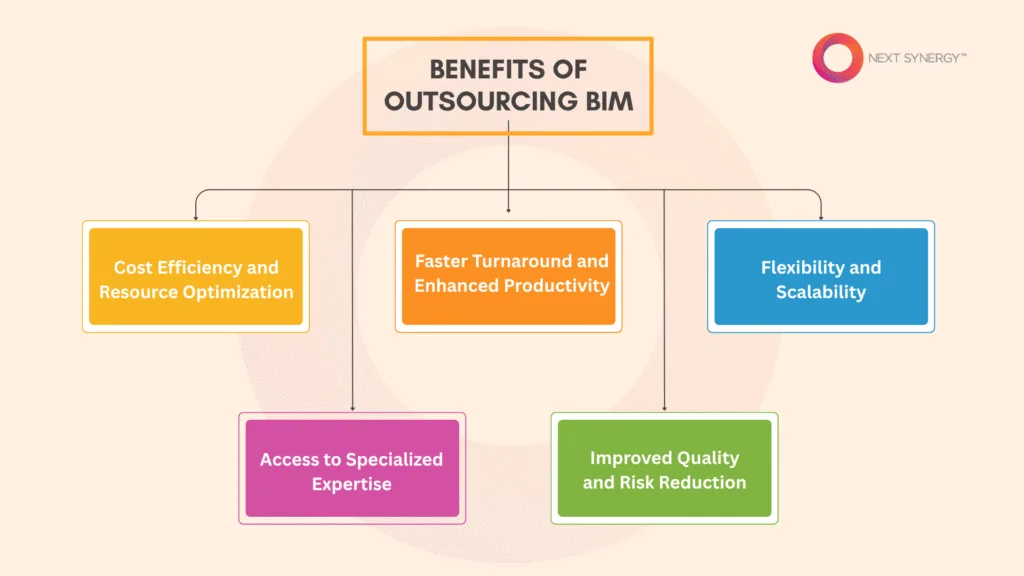
Cost Efficiency and Resource Optimization
Managing BIM operations internally can be expensive. It involves hiring experts, purchasing licenses, and maintaining software and hardware. Outsourcing eliminates these fixed costs and converts them into flexible, project-based expenses.
This allows firms to scale resources based on workload and project complexity. Many companies report a 30–40% reduction in modeling costs after shifting to outsourced BIM services. The savings can then be redirected toward design innovation or client engagement, strengthening the overall value of each project.
Access to Specialized Expertise
BIM outsourcing firms often employ experts skilled in multiple disciplines-architecture, structural, MEP, and infrastructure modeling. These specialists bring years of cross-industry experience and an understanding of diverse international standards.
Their familiarity with advanced tools such as Revit, Navisworks, and Tekla-some of the best BIM software used globally-ensures high-quality deliverables with fewer errors.
For architects and contractors, this expertise translates into better model accuracy, effective coordination, and faster approvals from clients and consultants.
Faster Turnaround and Enhanced Productivity
Outsourced BIM teams work across time zones, ensuring round-the-clock progress. This continuous workflow shortens delivery times and helps firms meet tight project deadlines.
The use of structured BIM execution plans and real-time collaboration tools further reduces bottlenecks. When deadlines tighten and internal teams face overload, outsourcing acts as an immediate productivity booster without compromising quality.
Improved Quality and Risk Reduction
Experienced BIM partners follow strict quality control measures, ensuring every model aligns with the required LOD and project standards. Their proactive clash detection and coordination reduce construction rework, saving both time and cost.
Many firms see fewer RFIs and change orders due to cleaner, conflict-free models. By outsourcing, firms transfer a portion of project risk to their partners, gaining an extra layer of accountability and assurance.
Flexibility and Scalability
Outsourcing provides the agility modern firms need. Whether it’s a single residential project or a large commercial complex, resources can be scaled up or down easily. This flexibility allows firms to take on more projects without stretching internal teams.
For growing architecture and construction companies, this is a vital competitive edge that supports consistent delivery and client satisfaction.

Challenges and Risks You Should Know Before Outsourcing BIM
While outsourcing BIM brings clear advantages, it also comes with challenges that you need to manage carefully. Understanding these risks helps you make smarter outsourcing decisions and maintain control over your projects.

Communication and Coordination Gaps
When your team and the BIM partner work in different time zones, miscommunication can happen. Without clear instructions, project updates may slow down or become confusing. The solution lies in setting fixed communication channels, weekly review calls, and well-defined BIM execution plans. These keep everyone aligned and prevent misunderstandings that could delay delivery.
Data Security and Confidentiality
You often share sensitive project data with your outsourcing partner. If proper security protocols aren’t followed, this can create risks of data leaks or unauthorized access. Always ensure your partner follows strict NDAs, uses secure servers, and complies with international data protection standards. A transparent data-sharing process builds trust and keeps your intellectual property safe.
Quality Control and Accountability
Different vendors may follow different modeling standards, leading to inconsistencies in quality. You must establish detailed quality checklists, LOD definitions, and review processes before work begins. Regular audits and sample reviews help maintain accuracy and consistency throughout the project.
Cultural and Workflow Differences
Every team works differently. If your outsourcing partner’s workflow doesn’t match yours, progress can slow down. To avoid friction, start with a pilot project. It helps both sides adapt to each other’s processes before moving to large-scale collaboration.
How Construction Firms Choose the Right BIM Partner
Choosing the right BIM partner can shape the success of your entire project. It’s not just about technical skills-it’s about finding a team that understands your goals, workflow, and quality standards. When you outsource, you want a partner who acts as an extension of your in-house team, not just a vendor delivering models.
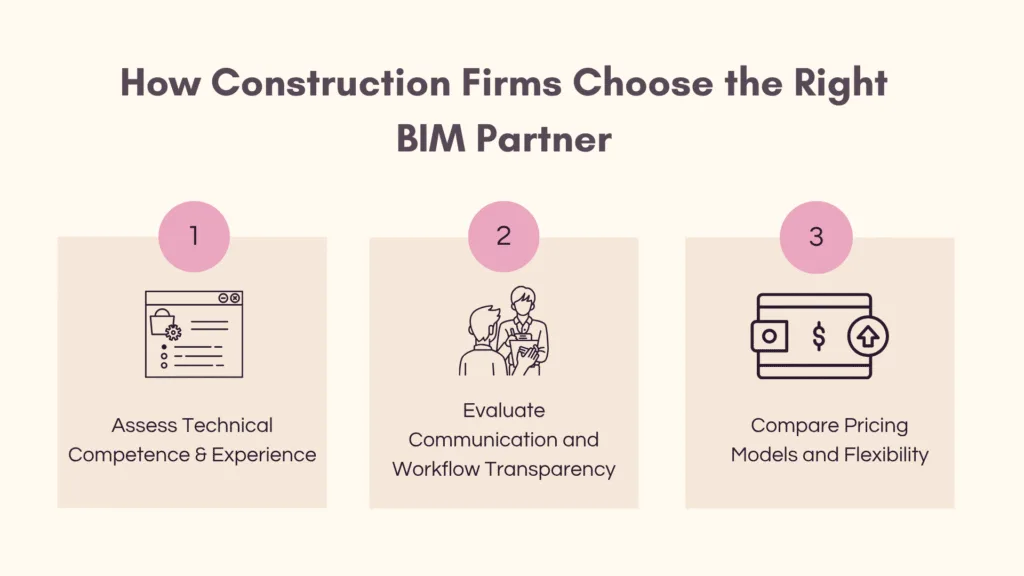
Assess Technical Competence and Experience
Start by checking the firm’s technical expertise. Ask about their experience with tools like Revit, Navisworks, and Tekla. Review their portfolio to see if they’ve handled projects similar to yours-residential, commercial, or infrastructure.
You should also look for proven experience with 4D, 5D, and MEP coordination. A reliable BIM partner will show measurable results, such as reduced clashes, faster turnaround, and improved documentation accuracy.
Evaluate Communication and Workflow Transparency
Clear communication is key to outsourcing success. Choose a BIM provider who maintains open, consistent updates through video calls, shared dashboards, or project management platforms. Request details about their collaboration process-how they handle revisions, approvals, and issue tracking. The best partners maintain transparency in every phase and ensure you always know the project’s real-time status.
Compare Pricing Models and Flexibility
Pricing should fit your project scope and duration. Some BIM partners offer hourly, milestone-based, or dedicated resource models. Go with one that provides flexibility and cost clarity. Avoid the lowest quote if it compromises quality or support.
Read More: How to Choose the Right BIM Services ProviderPartnering with Next Synergy Solution for Smarter BIM Collaboration
Next Synergy Solution stands out as a trusted partner for architects, engineers, and construction firms aiming to make the most of BIM outsourcing. The company combines technical expertise with a deep understanding of real-world project challenges. From concept modeling to 7D facility management, its team delivers precise, data-rich BIM models that improve coordination and reduce costly design conflicts.
What makes Next Synergy different is its focus on collaboration-every project is managed with clear communication, transparent reporting, and a commitment to deadlines. The firm uses advanced tools and cloud-based platforms to ensure smooth information flow between teams, no matter where they are located.
Whether you manage residential builds or complex infrastructure, Next Synergy Solution helps you achieve accuracy, speed, and value in every phase of your project. Partnering with them means working smarter, scaling faster, and bringing your BIM goals to life with confidence.
Conclusion
Outsourcing BIM has become a strategic move for firms that want precision, flexibility, and speed in today’s competitive market. It helps architects and construction teams focus on design and delivery while experts handle modeling, coordination, and data management.
As global adoption grows, partnering with a reliable provider like Next Synergy Solution ensures access to advanced tools, skilled professionals, and seamless collaboration. The future of construction belongs to firms that embrace smarter workflows-and outsourcing BIM is a key step toward that future. It’s not just a service; it’s a smarter way to build.