
Do you ever wonder how a building is transformed from a simple sketch into a fully realized structure in the digital world? Most of it is possible because of BIM (Building Information Modeling).

BIM Modeling services are not limited to just 3D drawings. However, there’s an entire process in place that captures design, construction, and lifecycle data in one location. Every architect, engineer, and contractor could interpret a model differently. That’s what led to delays, change orders, and spiraling costs. Industry users can thus lean on something called the Level of Development (LOD).
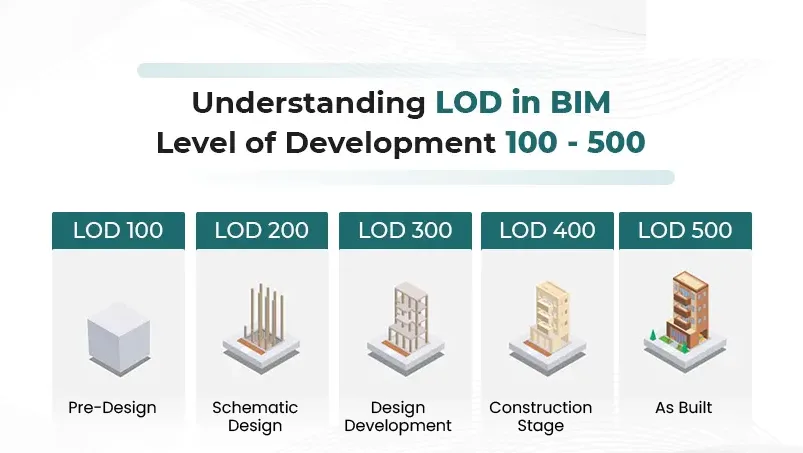
It acts as a common language in AEC projects, which tells you exactly how much detail you can rely on at each stage of a model, from a rough concept like LOD 100 to a precise record of what’s built with LOD 500.
Let’s break down everything about BIM LOD: what it means, why it matters, and how each stage (100, 200, 300, 350, 400, and 500) shapes the success of a project.
Understanding BIM Level of Development (LOD)
In BIM, Level of Development (LOD) sets the standard for how much detail and reliability you can expect from a model at a given stage. It’s a scale usually followed by BIM Integration services to provide rough concepts and the as-built model, which you can trust for construction & operations.
When you’re bidding, planning, or coordinating with subcontractors, you know exactly what the model represents and what it doesn’t.
Level of Detail vs. Level of Development
These two terms are often confused. They sound similar but mean very different things in practice.
| Term | What It Means | Why It Matters |
| Level of Detail | Suggests the level at which the graphic or visual detail is shown in the model. | A wall may show lines, textures, or materials, but that doesn’t guarantee the accuracy of the data. |
| Level of Development | It describes the reliability and usability of the information in the model for decision-making. | A wall defined at LOD 300 will be backed by data that you can depend on for coordination. |
Role of LOD in Accuracy, Reliability, and Usability
With LOD, stakeholders see how much they can rely on the model at any point. That shared understanding reduces confusion, rework, and cost overruns.
The LOD can offer the following :-
- Accuracy to teams who can trust the model to reflect real-world dimensions and data.
- Reliability for contractors and engineers in making decisions after gauging the level of confidence in each element.
- Usability to owners and operators who can continue using the model beyond construction, for maintenance and facility management.
A short history of BIM LOD
The American Institute of Architects (AIA) came up with the first formal LOD definitions via their E202‑2008 protocol in 2008. It helped set up levels 100 through 500 to give teams a shared baseline.
A few years later, BIM Forum stepped in and built a spec that adds examples, practical guidance, and interpretation to AIA’s original definitions.
More recently, ISO standards like ISO 19650 have brought a global structure to BIM workflows, although they do not specifically target LOD per se. They enable architectural modeling services teams to set the foundation for consistency, regardless of their location or the tools they use.
- Unified expectations across borders
- Easier model exchange between teams and software
- Future-ready workflows, ready to plug into new tech
Why Consistency Among Stakeholders Matters
When every architect, engineer, and contractor uses the same LOD definitions, the model stops being ambiguous and brings more clarity.
You can also adopt architectural design documentation services to further the precision, which helps trim mistakes and keeps projects on track.
- Stakeholders work from the same checklist
- Fewer clashes, faster coordination
- Clear handoff from design to build and beyond
What are the different stages of LOD
There are different levels of LOD, which represent a clear progression from rough ideas to build-ready detail in distinct steps. Each of these models of LOD helps keep teams aligned when everyone reads at the same level, the same way.
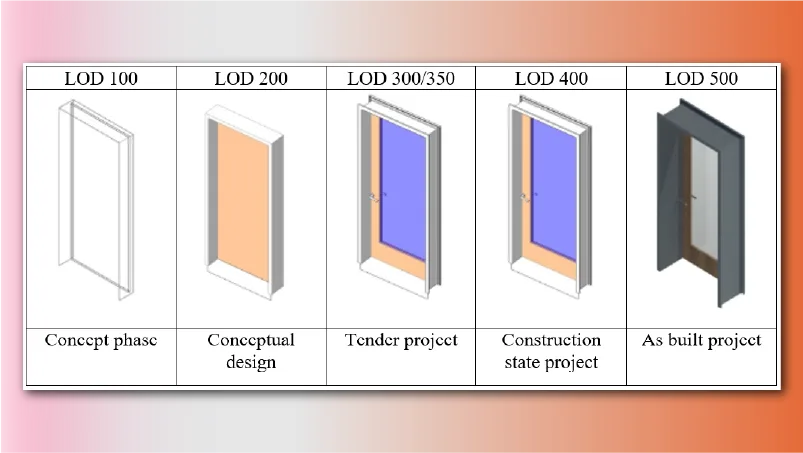
LOD 100: Conceptual
LOD 100 sets the base as this model acts as a placeholder with approximate size, shape, and location. Geometry stays simple. Data will remain limited to high-level targets like area, volume, and rough quantities. However, you would still be able to test options, rather than locking in decisions.
Purpose: The LOD 100 is useful in making high-level conceptual design, massing studies, and estimating the cost, along with feasibility checks.
Example: You’ll have a single box for the building with height, footprint, and orientation shown, without doors, windows, or system components.
LOD 200: Approximate Geometry
LOD 200 moves beyond placeholders and begins to give form to the model. There will be elements showing approximate shapes, sizes, and positions, but they won’t be exact.


Which means, there’ll be enough definition to study how systems interact and to generate early estimates with more confidence than at the conceptual stage.
Purpose: LOD 200 is often useful for the schematic design, space planning, and refined cost analysis. Teams can use it to evaluate feasibility and still have the flexibility to incorporate design elements.
Example: A wall will be displayed showing the estimated thickness and placement. But it’d lack the precise construction details or final finishes.
LOD 300: Precise Geometry
LOD 300 comes into play when you want accuracy in the model. It’s where the elements will be defined with specific dimensions, locations, and orientations that match how they’ll appear in real construction.


Quantities, materials, and connections carry enough weight for construction documents, permitting, and more reliable cost estimates.
Purpose: LOD 300 is crucial for design development and detailed coordination. It lets teams detect clashes, prepare construction drawings, and build with confidence that the model represents reality.
Example: There can be a wall modeled with actual thickness, height, material type, and openings for windows or doors. It’ll be in a ready position for direct use in construction documents.
LOD 350: Detailed Connections
LOD 350 adds another layer by showing how different building systems and components connect in real life.


At this stage, the users ensure everything fits together without conflict. Contractors, fabricators, and engineers rely on this to avoid costly rework once construction begins.
Purpose: LOD 350 is highly useful for advanced coordination, often implemented as a part of structural modeling services. It enables the team to resolve clashes between architectural, structural, and MEP systems before anything is built on-site.
Example: A wall can feature its door opening and appear complete with frame details. Also, there’ll be a detailed display of how it ties into adjoining structural or mechanical elements.
LOD 400: Fabrication and Assembly
The LOD 400 is a stage that takes the model to a build-ready stage. There are elements that appear accurate in terms of size and placement, while also meeting the exact specifications required for fabrication and installation.

Each of these pieces aligns with how it will actually be built on-site, leaving little room for interpretation.
Purpose: LOD 400 supports fabrication as it will have detailed construction planning and installation sequencing. The contractors can lead with confidence as they can see that the model can be built in the field without major adjustments.
Example: A wall will be modeled with precise layers, including studs, insulation, drywall, and finishes, which appear ready for fabrication and installation by subcontractors.
LOD 500: As-Built
LOD 500 represents the completed project in its final, verified form. This is the last and final stage of LOD, where each element in the model matches what has been installed on-site, with exact dimensions, materials, and performance data.
Owners rely on this stage long after construction is over.
Purpose: LOD 500 is necessary for the facility management, operations, and lifecycle planning. The owners receive a reliable record of the building for maintenance and long-term asset management.
Example: A wall will be constructed to represent the exact material, insulation type, fire rating, and verified dimensions as built, matching the physical construction.
Why is LOD Important?
There are multiple benefits that stakeholders in the AEC industry can look into when implementing LOD models.
Some of those are :-
Help in collaborating with precision
LOD enables setting a shared expectation of model accuracy among architects, structural engineers, and MEP teams. They can coordinate without ambiguity, and thus each system is modeled to the right level of reliability.
Preventing error and rework
Often, RFIs (Requests for Information) and change orders occur due to misaligned interpretations of the model. But when you define LOD, everyone in the team knows what information can be trusted at a given point, which reduces redesign cycles and field corrections.
Enabling cost and schedule control
Estimators and schedulers rely on the accuracy of quantities and assemblies in the model. Anything higher than LOD 300 would mean that the cost plans and project timelines are no longer rough estimates.
Common Challenges in Implementing BIM LOD And How to Choose the Right Level
Implementing LOD in BIM projects involves several stages. And each of these stages demands agreement, precision, and resources.
Firms often face difficulties that don’t stem from the concept itself, but rather from how it is applied across different teams and platforms. They usually consult with the BIM services provider company to help overcome common challenges encountered while implementing BIM LOD.
Misunderstanding What LOD Really Represents
Many projects run into confusion between “Level of Detail” (graphic richness) and “Level of Development” (the reliability of information). Often, teams may overestimate the accuracy of a visually detailed model, which can lead to errors in procurement or scheduling.
Choosing the right LOD :-
Clarify from the start whether the model needs to inform design intent or construction execution. Early-phase models should maintain a LOD of 100–200 for flexibility, while coordination and tendering require a LOD of 300 or higher.
Uneven Adoption of Standards Across Firms
Not all firms consistently apply AIA, BIMForum, or ISO standards. One contractor’s LOD 300 may not match another’s, creating mismatched expectations.
What LOD to choose :-
Document LOD definitions in the BIM Execution Plan (BEP). It requires aligning all stakeholders, such as owners, designers, and contractors, on what each LOD means for your project before modeling begins.
Time and Cost Pressures
Higher LODs demand more modeling effort, data input, and review cycles. Pushing too far too early can waste resources, while stopping too low can leave teams with unreliable data.
Determine the LOD level :-
Balance the LOD with project phase, complexity, and budget. Infrastructure or industrial projects may justify a LOD 400 in design; a small residential project, however, likely does not.
Interoperability Between Platforms
Different software platforms handle geometry and data in varying ways. When models are transferred across tools, information can be lost or misinterpreted.
Choosing the right LOD :-
Select the LOD maturity level with the final use case in mind. If the owner’s facility team will rely on the model, ensure LOD 500 is delivered in a format compatible with their FM tools. For clash detection, align around neutral formats, such as IFC, at LOD 300–350.
Conclusion
BIM LOD has moved from being a design aid to becoming the backbone of reliable AEC workflows. By defining how much information a model carries at each stage, LOD reduces conflicts, sharpens cost control, and gives owners lifecycle-ready data.
Looking ahead, LOD will evolve with AI-driven automation, where models can progress levels faster with fewer manual inputs. The rise of digital twins will make accurate LOD non-negotiable, while global standardization will ensure consistency across borders and platforms.
At Next Synergy Solutions, we help firms translate these standards into practice bridging design, construction, and facility management through more innovative BIM strategies. If you’re aiming to future-proof your projects, adopting the right LOD framework is the place to start. Talk to our BIM experts and see how we can align your workflows with tomorrow’s standards.